
• Skip to primary navigation
  • Skip to main content
  • collections@thestorydurham.org
DRO logo

Durham Record Office

Durham County Record Office: the official archive service for County Durham and Darlington

  • About us
    • Projects
    • What we do
    • News
    • Friends of Durham County Record Office (FODCRO)
    • Governance
    • Policies
  • Our records
    • Coal mining and Durham collieries
    • Durham Light Infantry Archives
    • Information guides
    • Maps
    • Picture Gallery
  • Ask us
  • Family history
    • Birth, marriage and death records
    • Census records
    • Parish registers
    • Place names index
    • Nonconformist Church Registers
    • Wills
    • A to Z of other family history sources
  • Learning Zone
    • The Story of Jimmy Durham
    • Crook
    • Durham Market Place
    • Arts Award
  • Exhibitions
    • ‘Almost too horrible for words’ – the liberation of Belsen concentration camp, 1945
    • ‘Marvellous Diggers’ – The 1st Battalion DLI in Korea, 1952-53
    • ‘Adventurers and Pirates’ – Hetton Coal Company, 1820
    • Looking back at Consett Steel Works
  • Shop
    • Apply for quick search
    • Apply for research service
    • Order and pay for copies
    • Fees and charges
    • Publications
  • Search Options
    • Search the catalogue
    • Search Church Registers
    • Search Durham Collieries
    • Search Durham’s Hidden Depths
    • Search place names
    • Search interactive maps
  • Contents
  • ‘Adventurers and Pirates’ – Hetton Coal Company, 1820
  • Changing the world
  • A new era in coal mining history
  • Running the new colliery
  • The workforce content
  • The Hetton Colliery railway
You are here: Home / Exhibitions / ‘Adventurers and Pirates’ – Hetton Coal Company, 1820 / The workforce

The workforce

Part of an online exhibition to mark the Hetton Coal Company’s pioneering advances in mining and railway technology in 1820.

Perspective view of Hetton Colliery works and railway, c.1822 (NCB 1/X 37) - © Durham County Record Office

Thomas Hepburn (1795-1864)

The employers did not, of course, always agree with their workforce. Thomas Hepburn, leader of The Colliers’ United Association of Durham and Northumberland [The Pitmen’s Union], formed 1825, was a hewer at Hetton Colliery from 1822.
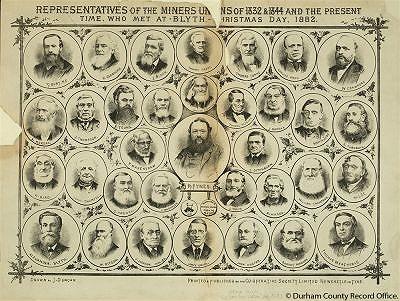
Representatives of the Miners Unions who met at Blyth, - Christmas Day, 1882', including an image of Thomas Hepburn (D/DMA 13/1/11) - © Durham County Record Office
Icon showing image can be enlarged

‘Representatives of the Miners Unions of 1832 and 1844 and the Present Time, who met at Blyth, – Christmas Day, 1882’, including an image of Thomas Hepburn (D/DMA 13/1/11).

Hepburn was born in Pelton in 1795 and, following the death of his father in a mining accident, started work at Urpeth Colliery at the age of eight. He worked at Lamb’ s Colliery, Fatfield and Jarrow Colliery before Hetton. In 1831 he led a successful strike that reduced boys’ working shifts from 18 hours to 12.

The coal owners fought back in 1832 and Hepburn lost his job and was victimised. Mowbray met Hepburn in August 1832 and insisted that the company would only hire miners if they quit the Union. By the end of the year the Union had collapsed.

Hepburn tried again to establish the Union in 1835 but was unsuccessful. He is recognised however as the forerunner of the Durham Miners’ Association (founded 1869) and is commemorated on miners’ banners and in an annual commemorative service at Heworth Church, where he was buried in 1864.
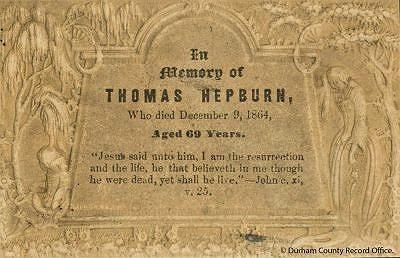
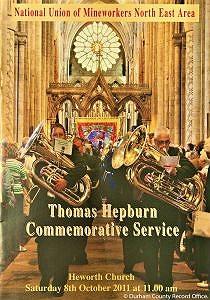
Funeral card for Thomas Hepburn, 9 December 1864(D/X 192/1) - © Durham County Record Office     Order of service for Thomas Hepburn commemorative service, Heworth Church, 8 October 2011 (D/X 1697/11) - © Durham County Record Office

Funeral card for Thomas Hepburn, 9 December 1864 (D/X 192/1)
Order of service for Thomas Hepburn commemorative service, Heworth Church, 8 October 2011 (D/X 1697/11).

Hetton Colliery relief fund

In January 1834, the Coal Company held the first annual meeting of a Relief Fund, to help workmen in need following, for example, an accident. Agents and workmen were encouraged to join the fund to which the company would contribute one sixth of the amount contributed by the workforce each fortnight.
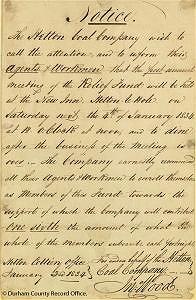
Notice of annual meeting of Hetton Colliery Relief Fund, 3 January 1834 (D/X 126/2) - © Durham County Record Office
Icon showing image can be enlarged

Notice of annual meeting of Hetton Colliery Relief Fund, 3 January 1834 (D/X 126/2).

Hetton Colliery disaster

The worst accident at Hetton Colliery was on 20 December 1860, when 22 men and boys lost their lives due to an explosion of inflammable gas, the youngest being three boys aged 16, and one aged 17.
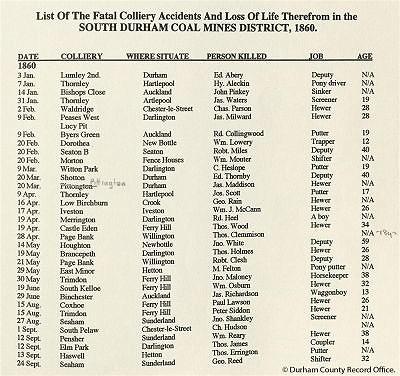
Fatal Colliery Accidents and Loss of Life in the South Durham Coal Mines District, 1860, page 1 of 2 (Library I/2) - © Durham County Record Office
Icon showing image can be enlarged
Fatal Colliery Accidents and Loss of Life in the South Durham Coal Mines District, 1860, page 2 of 2 (Library I/2) - © Durham County Record Office
Icon showing image can be enlarged

List of the Fatal Colliery Accidents and Loss of Life Therefrom in the South Durham Coal Mines District, 1860 – 2 pages from Ian Winstanley: Mining Deaths in Great Britain Volume 2, 1860 – 1869; Picks Publishing, 1995 (Library I/2).

Next – The Hetton Colliery railway

Back to ‘Adventurers and Pirates’ – Hetton Coal Company, 1820.

Durham County Council logo Accredited Archive Service logo

The Story
Mount Oswald
South Road
Durham
DH1 3TQ
collections@thestorydurham.org

  • Top of Page |
  • Legal Information | 
  • Accessibility Statement | 
  • Contact Us |

Copyright © 2025 · Developed by Durham County Council